
Cash Flow Forecasting Methods: From Data to Actionable Insight
Running out of cash is one of the biggest threats to small business survival. Yet many owners operate without a clear picture of their cash position beyond their bank balance.
Cash flow forecasting methods transform raw financial data into a strategic tool that helps you anticipate shortfalls, plan for growth, and make confident decisions. When you know what’s coming, you can act before problems arise.
What Cash Flow Forecasting Actually Means for Your Business
Cash flow forecasting is the disciplined practice of projecting your cash position over a defined period by estimating when money enters and leaves your business. It is not the same as profit forecasting. A business can be profitable on paper yet run out of cash because invoices sit unpaid or inventory ties up capital. For small business owners, this distinction is critical. Your bank account does not care about accrual accounting-it cares about timing. A cash flow forecast answers one essential question: will you have enough cash on hand when obligations come due?
Without this visibility, you operate blind. You make spending decisions without knowing whether you can actually cover payroll two weeks from now. You turn down growth opportunities because you cannot assess whether you have liquidity to support them. Worse, you discover cash shortages only when they become emergencies, forcing you into expensive short-term borrowing or payment negotiations that damage supplier relationships. Small business owners who implement forecasting shift from reactive crisis management to proactive planning. They identify gaps weeks or months ahead, giving them time to secure financing, adjust payment terms, or reduce discretionary spending. The financial data already exists in your accounting system. Forecasting simply organizes that data into a forward-looking tool.
The Core Variables That Drive Your Cash Position
Three categories of cash movement determine your forecast: operating activities, investing activities, and financing activities. Operating cash includes customer payments, payroll, vendor invoices, and utilities. This is where most small businesses focus because it represents the bulk of daily cash flow. Investing activities involve equipment purchases or asset sales.
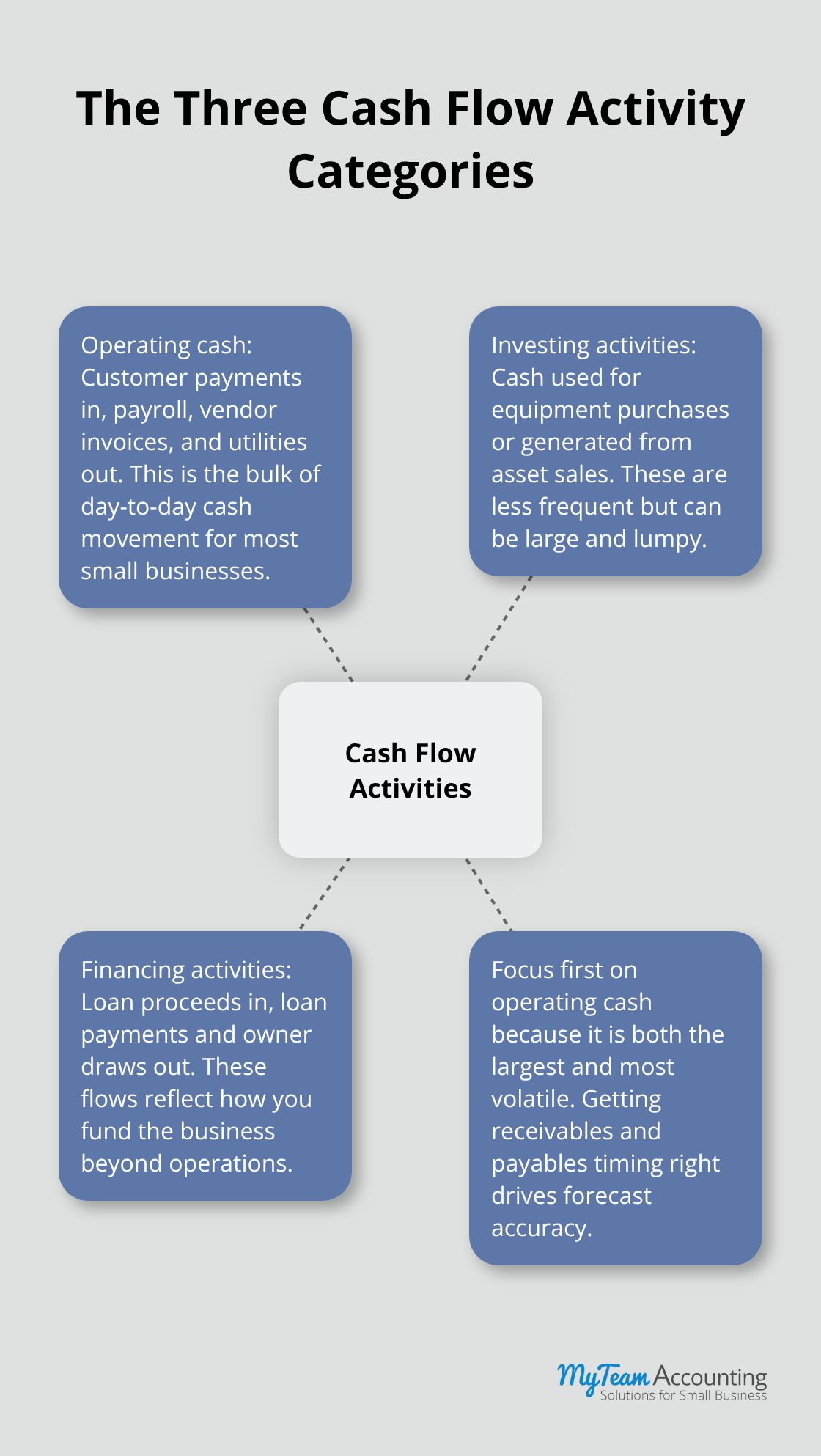
Start with operating cash because it is the largest and most volatile. Track accounts receivable aging closely. If your customers pay in 30 days on average but you forecast collections as if they pay in 15, your forecast will be dangerously optimistic. Historical payment behavior matters more than invoice terms. Similarly, accounts payable timing shapes your outflows. If you have 45 days to pay suppliers but you forecast payments in 30 days, you will overestimate cash outflows and underestimate your available cushion.
Payroll is predictable and fixed, making it one of the easiest variables to forecast accurately. Seasonal businesses must track how sales volume and receivables fluctuate month to month. A summer-heavy contractor forecasts very different cash patterns in winter than year-round operations do. Include one-time events: tax payments, equipment repairs, owner distributions, or loan refinancing. These surprise many business owners because they do not appear in regular P&L statements until they hit the bank account.
Why Most Forecasts Fail and How to Avoid It
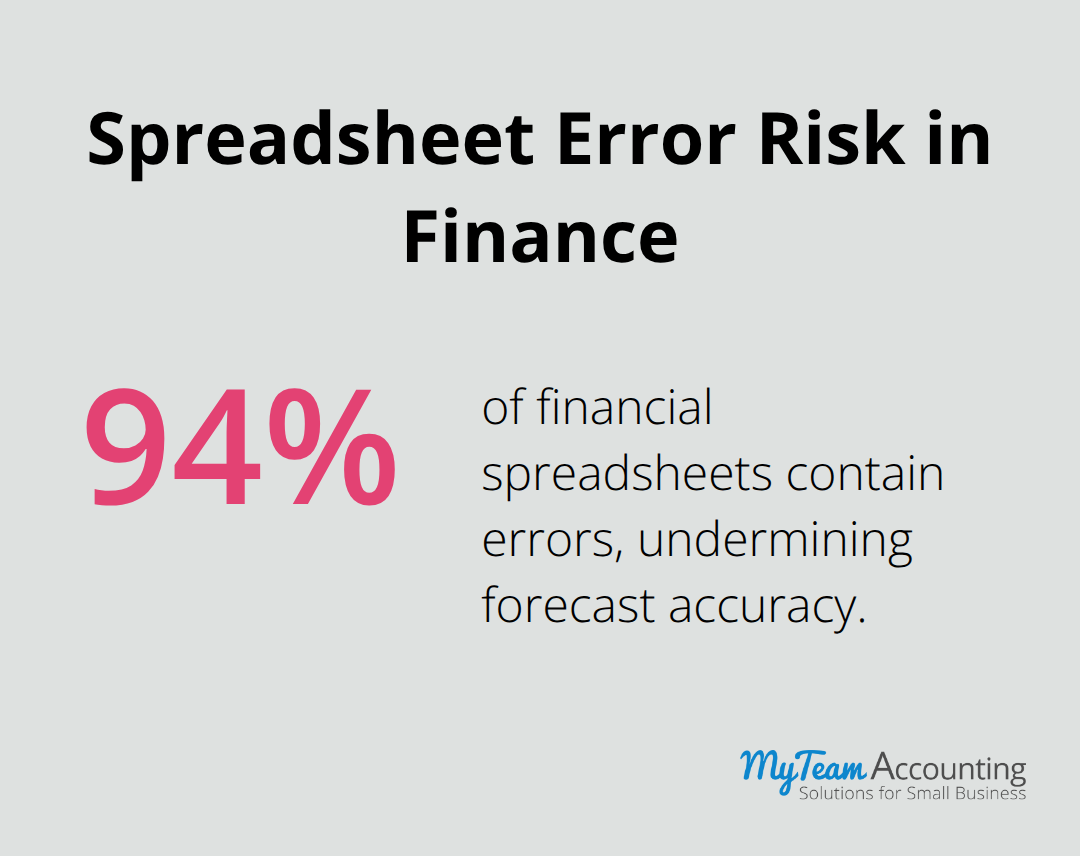
The most common forecasting error is optimism bias. Sales projections tend to be inflated because owners focus on opportunities rather than historical close rates. Customer payment delays are underestimated because owners assume best-case timing. Spreadsheet-based forecasts introduce formula errors that compound over time. Research shows that up to 94 percent of financial spreadsheets contain errors. If your forecast rests on a flawed formula, every projection downstream is wrong.
Manual data entry creates another layer of risk. Each time you copy numbers from QuickBooks Online or Xero into a spreadsheet, you introduce the possibility of transcription errors or stale data. A forecast built last month becomes increasingly inaccurate as new transactions occur and customer payment patterns shift. The antidote is grounding your forecast in actual data, not assumptions. Use your last 12 months of customer payment history to inform receivables timing. Review supplier payment terms and actual payment behavior.
Building Accuracy Into Your Forecast
Try a short horizon first-typically two to four weeks-where accuracy is highest. Extend to 13 weeks for medium-term liquidity planning. Most small businesses do not need a 12-month forecast; a rolling 13-week forecast updated weekly maintains accuracy and keeps your focus on the near term where you can actually influence outcomes. When you work with an outsourced CFO or bookkeeping firm, they handle data collection and formula maintenance, eliminating the spreadsheet error risk entirely. They also bring objectivity to your assumptions, challenging optimistic projections and ensuring your forecast reflects reality, not wishful thinking. This foundation of accurate data and realistic assumptions positions you to move from forecast to action-identifying where cash gaps will emerge and what decisions you need to make today.
Methods That Actually Work for Your Business
Extract Real Payment Patterns from Your Historical Data
Historical data is your most reliable forecasting asset, yet most small business owners ignore it. Pull your AR aging report to view outstanding invoices by aging bucket (ex: 0–30, 31–60, 61–90, 90+ days). Calculate your actual average payment cycle by customer segment, not by assuming invoice terms. A client selling to contractors might have 60-day invoice terms but actually collects in 90 days because of project delays. Another selling to retailers might invoice at net 30 but collect in 15 because of their strong payment discipline. These real patterns matter far more than what your contracts say.
Once you know your actual payment timing, you can build a forecast grounded in behavior rather than theory. Look at seasonal patterns in your sales and expenses. If you run a landscape business, January through March will show near-zero revenue and fixed overhead costs; June through September will show peaks. A 13-week rolling forecast captures these shifts accurately, whereas a single annual forecast obscures them entirely. Start by comparing your last three years of monthly revenues and expenses side by side. You will see where the volatility lives, and that volatility is what kills unprepared cash positions.
Leverage QuickBooks Online and Xero Reporting Features
QuickBooks Online and Xero reporting features both offer built-in reporting that feeds forecasting. QuickBooks Online generates aged receivables and payables reports that show exactly when cash is likely to arrive and leave. Export these into a simple spreadsheet and extend them forward using your historical payment cycle data. Xero’s cash flow forecasting helps you predict your future cash position and track which payments are due, enabling informed decisions for your small business.
The real advantage of these platforms is that they eliminate data entry errors when you pull numbers directly into your forecast model. You avoid the transcription mistakes that plague spreadsheet-based forecasts. This direct connection between your accounting software and your forecast keeps your projections current as new transactions settle, rather than forcing you to update stale numbers manually each week.
Partner with Professional Advisory Support for Accuracy and Discipline
An outsourced CFO or advisory firm transforms your forecasting from a static exercise into a strategic practice. My Team Accounting helps small business owners build forecasts that connect directly to their QuickBooks Online or Xero data, removing the spreadsheet transcription risk entirely. A professional CFO challenges your assumptions, flags overly optimistic revenue projections, and incorporates real supplier and customer payment behavior into your model. They also update your forecast weekly or bi-weekly as new transactions settle, keeping your projections current rather than stale.
This ongoing discipline costs far less than the emergency financing or missed opportunities that result from poor visibility. When you combine accurate historical data with professional oversight and connected accounting software, your forecast shifts from a static document into a living tool that shapes your decisions on payroll timing, vendor negotiations, and growth investments. With this foundation in place, you are ready to translate your forecast into concrete action-identifying where cash gaps will emerge and what decisions you need to make today to protect your business tomorrow.
How to Act on Your Cash Flow Forecast
Identify Cash Gaps and Set Your Minimum Threshold
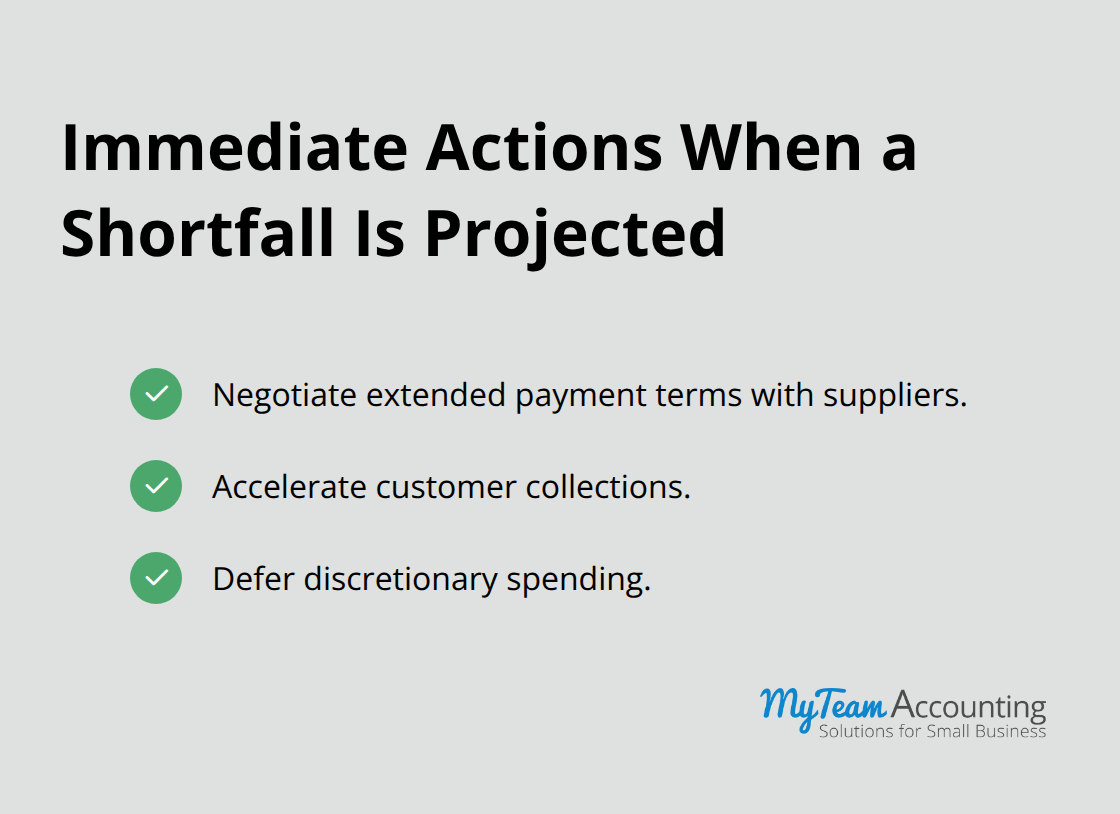
Your forecast only delivers value when it drives decisions. A business owner who spots a projected cash shortfall three weeks out can negotiate extended payment terms with suppliers, accelerate customer collections, or defer discretionary spending. That same owner discovering the shortfall when the bank account hits zero has no leverage and faces emergency borrowing at premium rates. The difference between these two scenarios is action taken early.
Start by identifying your cash gap points in the 13-week forecast. These are the specific weeks where projected outflows exceed inflows and your cash balance dips below your minimum operating threshold. Most small businesses need a cash buffer equal to two to three weeks of operating expenses. If your weekly payroll and fixed costs total $15,000, your minimum buffer should be $30,000 to $45,000. When your forecast shows the balance falling below this threshold, you have a problem to solve now, not later.
Solve Collections and Payment Timing Issues
The solution depends on what drives the gap. If customer payments arrive late, your action is collections-focused. Pull your aging report in QuickBooks Online or Xero and identify which customers are behind. Contact them directly rather than waiting for the normal follow-up cycle. Offering a small discount for early payment often costs less than short-term financing.
If the gap stems from supplier payment timing, you have leverage to negotiate terms. Many suppliers offer net 45 or net 60 terms because they assume you will ask. Few business owners actually do. A conversation with your vendor about extended payment terms can push cash outflows back two to four weeks, transforming a shortage into surplus. Your forecast makes this conversation concrete. You can show the supplier exactly when you need the extended terms and when you will catch up, demonstrating that the request is temporary and business-driven, not a sign of financial distress.
Optimize Working Capital Across Three Levers
Working capital optimization flows directly from your forecast data. Most small business owners focus on cutting costs when cash tightens, but working capital has three levers: receivables, inventory, and payables. Your forecast reveals which lever to pull. If slow-paying customers create a cash gap, aggressive collections or payment term changes solve the problem faster than cutting payroll or overhead. If you carry excess inventory, your forecast shows the cash release from selling it down. If you have room to extend payables, that buys time.
An outsourced CFO helps you model these scenarios in your forecast before you implement them, showing the cash impact of each decision. This prevents the common mistake of cutting discretionary spending when the real solution is accelerating receivables.
Plan Growth Without Creating Cash Crises
Growth planning without cash flow forecasting is dangerous. A business that lands a large new contract or secures a big customer often faces a cash crunch because revenue growth outpaces the cash collection cycle. You invoice $100,000 in month one but collect it in month three while your team, materials, and overhead costs hit your bank account immediately. Acting on your cash flow forecast identifies this timing mismatch weeks ahead, allowing you to secure a line of credit before you need it or negotiate upfront deposits with the new customer. This proactive approach to growth financing prevents the scenario where businesses cannot afford to fulfill the success they just won.
Your forecast becomes the document you share with lenders when seeking working capital financing. Banks want to see the specific cash gaps you are solving for, not just a profit-and-loss statement. A detailed 13-week forecast with conservative assumptions demonstrates financial discipline and gives lenders confidence that you understand your business and can manage growth responsibly.
Final Thoughts
Cash flow forecasting methods transform uncertainty into clarity and equip small business owners with the visibility they need to survive and grow. Throughout this guide, you have seen how historical data, connected accounting software, and disciplined forecasting practices work together to prevent cash crises before they happen. The businesses that thrive are not those with the highest profits on paper, but those with enough cash in the bank when obligations come due.
Implementing forecasting in your business does not require complex systems or months of preparation. Start with a simple 13-week rolling forecast built from your QuickBooks Online or Xero data, pull your aged receivables and payables reports, apply your actual payment cycle timing, and project forward. Update it weekly as new transactions settle, and within a month you will make better decisions about payroll timing, vendor negotiations, and growth investments because you can see the impact on your cash position before you commit.
Professional advisory services accelerate this transformation significantly-an outsourced CFO or accounting firm handles the data collection, formula maintenance, and weekly updates that keep your forecast current and error-free while bringing objectivity to your assumptions and connecting your forecast directly to your accounting software. Schedule a conversation with a CFO or accounting advisor who can assess your current forecasting process and build a system tailored to your business. The cash visibility you gain will change how you lead.