

Designing a Bespoke QuickBooks Online Curriculum for Growth
Many small business owners struggle to unlock QuickBooks Online’s full potential, leaving money on the table and making decisions based on incomplete financial data.
A bespoke QuickBooks Online curriculum transforms how your team manages finances, turning confusion into confidence and data into actionable insights.
This guide walks you through designing training that fits your business, your goals, and your growth trajectory.
Where Does Your Team Actually Stand with QuickBooks
Most small business owners assume their team knows QuickBooks Online because someone set up an account years ago and invoices keep going out. This assumption costs money. A diagnostic conversation with your finance staff typically reveals gaps: the accounts payable person cannot run aging reports, the bookkeeper enters transactions but never reconciles, and nobody understands the chart of accounts structure well enough to pull accurate profit-and-loss data by department.
Observe Current Workflows and Identify Gaps
Start with two weeks of observation without intervention. Watch what reports your team pulls, how long reconciliations take, and which tasks get delayed or skipped. You will quickly spot whether knowledge gaps stem from insufficient training, poor system setup, or both. Ask direct questions: Can your team explain why your cash balance does not match your profit? Do they know the difference between accrual and cash reporting? Can they set up a new customer or vendor without calling you? The answers reveal whether you need foundational training, advanced feature training, or a complete system overhaul paired with training.
Pinpoint Financial Weak Spots
Your pain points are specific to your business model, not generic. A service-based firm struggles with project profitability tracking; a product company needs inventory accuracy; a construction business requires job costing precision. Interview your leadership team about what financial questions they cannot answer today. Do you know which customers are actually profitable? Can you forecast cash flow beyond 30 days? Are your financial statements ready for a bank conversation or investor pitch?
These questions expose the real training priorities. A well-designed curriculum addresses these exact gaps rather than teaching every QuickBooks feature equally. Map your growth strategy to financial capabilities: if you hire aggressively next quarter, your team needs payroll setup expertise and budget forecasting skills now, not six months from now. If you consider exit planning, your curriculum should emphasize clean balance sheet management and multi-year financial trends. The training that matters most is the training that directly supports your next business milestone.
Align Learning to Revenue Impact
Training time is expensive, so every hour must drive measurable financial outcomes. Define three to five specific learning objectives tied to revenue, cash flow, or cost reduction. Instead of the vague goal to learn QuickBooks better, set targets like reduce invoice processing time from two days to same-day, implement monthly cash flow forecasting, or eliminate 50% of reconciliation errors within 60 days. These objectives become your curriculum benchmarks.
A bespoke curriculum skips topics that do not matter to your business and goes deep on the areas that move the needle. Your team does not need 40 hours of general QuickBooks training; they need custom training that solves your specific financial management problems. With clear learning objectives in place, you can now design the actual training framework that transforms these priorities into structured, actionable modules your team will complete and apply.
Building Your Training Framework
Establish Your Chart of Accounts as the Foundation
Start with your chart of accounts structure because everything else cascades from this foundation. Most small businesses inherit a disorganized chart of accounts from years of ad-hoc additions, making financial reporting unreliable and training confusing. Your curriculum must begin here, not with invoice entry or bank reconciliation. Audit your current chart of accounts for redundant accounts, misclassified expenses, and missing cost centers that align with your growth strategy.
If you operate multiple business lines or service offerings, set up class tracking correctly from day one so your team can answer questions like which product line actually produces profit or which customer segment drains resources. This foundational work takes two to four weeks but prevents months of corrupted data later. Once your chart of accounts reflects your actual business structure, you can build three core training modules around it: transaction entry with proper account selection, monthly reconciliation workflows that catch errors before they compound, and report creation that maps to your leadership questions.
Tailor Core Modules to Your Business Model
Your training should not be generic QuickBooks instruction but specifically tied to your business. A construction firm needs job costing and cost code mapping; a service business needs project profitability tracking; a retail operation needs inventory valuation methods. Teach the QuickBooks mechanics through the lens of your specific use case, not in isolation. Your team will retain knowledge faster and apply it immediately when they see how each feature solves their actual work problems.
Advanced features matter only when your foundation is solid, so resist the urge to train your team on advanced functionality before they master the basics. Many firms waste training hours on dashboard creation or scenario planning when their team cannot reconcile accounts or classify expenses correctly. Once your core modules are complete and your team demonstrates competency through hands-on practice, then layer in advanced features that directly address your financial gaps.
Integrate Training with Your Actual Workflows
Integration with your existing business processes is critical: train your accounts payable person on the exact approval workflow you use, not a generic approval process. Train your bookkeeper on your specific reconciliation cadence and the exact reports your leadership team needs monthly. This means your curriculum must include documentation of your current processes, identification of inefficiencies, and retraining on the improved workflows you implement.
Build a formal procedures manual alongside your training program so your team has written reference materials and new hires can onboard faster. The training framework succeeds when your team executes their daily work in QuickBooks without confusion and produces reliable financial data that supports your growth decisions within 60 days of completing the core modules. With your framework in place and your team trained on the fundamentals, you now need a structured approach to measure whether the training actually sticks and drives real financial improvements.
Implementing and Measuring Training Success
Practice with Real Transactions in a Sandbox Environment
Training completion certificates mean nothing if your team reverts to old habits within two weeks. The real test comes when your accounts payable person faces a vendor invoice, your bookkeeper closes the month, or your owner needs cash flow data for a board meeting. Structured practice with scenarios from your actual business forces retention and builds muscle memory before high-stakes work. Set up a sandbox environment in QuickBooks Online where your team processes 20 to 30 real transactions from your business without affecting live data. Use actual invoices, bills, and bank statements from the past three months so the training feels immediate and relevant. Your accounts payable person should practice the exact approval workflow you documented, your bookkeeper should reconcile the actual bank account balance from last month, and your controller should pull the specific reports your leadership team needs. This hands-on practice typically takes three to five days spread across two weeks and reveals exactly where knowledge gaps remain.
Verify Competency Through Explanation and Review
After each practice session, have your team explain why they classified a transaction to a specific account or how they decided between accrual and cash reporting. These explanations expose shallow understanding that certification tests miss. Once your team demonstrates competency in the sandbox, they move to live transactions with a structured review process where someone else audits their work for 30 days. This peer review catches errors before they corrupt your financial data and reinforces correct procedures through repetition.
Reinforce Learning Through Monthly Sessions and Peer Teaching
Knowledge decay in financial training is real and predictable. Schedule monthly group sessions where your team reviews one specific QuickBooks workflow together, shares challenges they encountered that month, and discusses how they solved them. Assign one team member each month to teach a 15-minute session on a feature they mastered, which forces deeper understanding and distributes training ownership beyond your finance manager.
Track Metrics That Connect to Business Outcomes
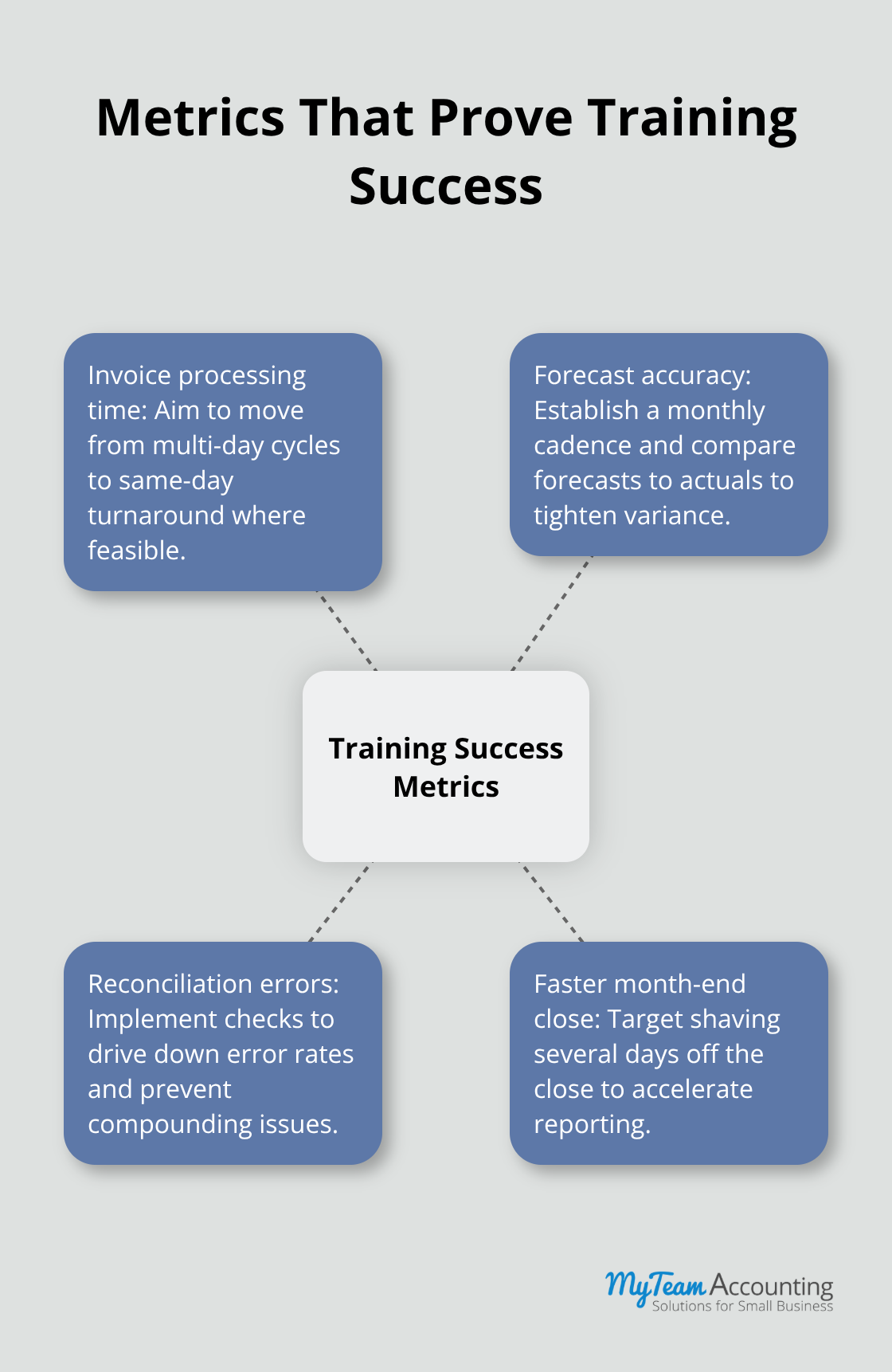
Track specific metrics that matter to your business: reduce invoice processing time and improve forecast accuracy, eliminate reconciliation errors, or close your books three days faster each month.
Address System Issues Before Blaming Performance
Many firms discover during this measurement phase that their chart of accounts still needs refinement or their bank feed setup creates duplicate transactions. Address these system issues immediately rather than blaming your team for poor performance. When adoption metrics improve and your financial reporting quality rises, you have evidence that your bespoke curriculum actually works and where to double down on reinforcement for maximum impact. Your team now executes their daily work in QuickBooks with confidence, produces reliable financial data that supports growth decisions, and demonstrates measurable improvements in speed and accuracy within 90 days of completing core training modules.
Final Thoughts
A bespoke QuickBooks Online curriculum transforms your team from passive software users into confident financial operators who drive growth decisions with reliable data. Your three-phase approach-diagnosing your specific financial gaps, building training modules tied directly to your business model, and measuring adoption through metrics that matter-delivers measurable results within 90 days. Your team processes invoices faster, reconciles accounts accurately, and produces financial reports that answer your leadership questions without delay.
When your finance team understands your chart of accounts structure, executes consistent workflows, and maintains clean data in QuickBooks, you gain the foundation for strategic financial decisions. You forecast cash flow with confidence, identify which customers or product lines actually generate profit, and spot cost overruns before they derail your budget. This financial clarity becomes your competitive advantage as you scale, hire aggressively, or pursue exit planning, and investors and lenders trust businesses with transparent, well-organized financial records.
Sustainable financial growth requires ongoing reinforcement, not one-time training. Schedule monthly group sessions to review workflows, assign peer teaching responsibilities to deepen ownership, and audit your QuickBooks setup quarterly for inefficiencies that emerge as your business evolves. Consider partnering with an outsourced CFO or accounting advisor who can validate your training outcomes, identify advanced capabilities your team is ready to master, and provide strategic guidance on financial decisions that support your growth trajectory.