
Stabilize Cash Flow Projections: Strategies for Predictable Finances
Most small business owners operate month-to-month without visibility into their cash position. This uncertainty makes it impossible to plan confidently or invest in growth.
When you stabilize cash flow projections, you transform finances from a source of stress into a strategic advantage. Predictable cash flow lets you make decisions based on data, not panic.
Stabilize Cash Flow Projections: Why Unpredictable Cash Flow Destroys Growth Plans
The Real Cost of Operating Without Visibility
Unpredictable cash flow forces small business owners into reactive survival mode. When you lack visibility into your cash position, you cannot commit to hiring, cannot negotiate confidently with suppliers, and cannot pursue growth opportunities even when they appear. According to Investopedia, cash flow represents the net amount of cash moving in and out of a business in a given period, and it directly determines whether payroll gets funded, bills get paid, and operations stay afloat. High revenue masks the real problem: a company generating significant sales can still collapse within weeks if timing gaps between customer payments and expense obligations go unmanaged. Late payments from clients, seasonal revenue dips, and unexpected costs create cash shortfalls that force expensive emergency borrowing or worse, missed payroll. Small business owners without visibility into their 30, 60, and 90-day cash positions make decisions based on guesswork rather than data, which means turning down profitable projects because cash feels tight, or overcommitting to expenses that drain runway during slow months.
How Forecasts Eliminate the Crisis Cycle
Accurate cash flow forecasts eliminate the guesswork. You see exactly when money arrives and when it leaves. When you know that a major customer pays net 30 but your payroll runs on the 15th, you arrange a short-term line of credit before the gap emerges, not after. A rolling 90-day forecast updated weekly reveals which weeks carry genuine shortfall risk and which carry surplus opportunity. This visibility transforms how you operate: instead of hoarding cash nervously, you deploy it strategically. Instead of declining work because cash feels uncertain, you accept projects knowing precisely when payment arrives and whether you can cover the operational costs. Tools like QuickBooks Online and Xero automate this process. They pull real transaction data from your bank accounts and chart of accounts, eliminating manual spreadsheet errors that plague static forecasts. The forecast equation is simple but powerful: inflows minus outflows equals net cash flow. When you automate this calculation and update it weekly with actual data, you catch problems 6 to 8 weeks before they hit, giving you time to take preventive action like renegotiating payment terms or adjusting spending. Forecasting software provides dynamic visuals and scenario modeling that spreadsheets cannot match, allowing you to test what happens if a major client delays payment by 15 days or if you hire an additional team member next quarter.
Predictable Cash Flow Enables Strategic Growth
Predictable cash flow serves as the foundation for deliberate business growth rather than desperate scrambling. When your 90-day forecast shows consistent positive cash position, you commit to hiring without fear of missing payroll. You invest in tools and systems that improve efficiency because you know cash will support the upfront cost. You negotiate better terms with suppliers from a position of strength instead of accepting whatever terms keep you afloat. Lenders and investors also respond to forecasts: a business owner presenting structured, cloud-based cash projections derived from real accounting data gains credibility that translates into better loan terms and lower borrowing costs. Most critically, stable cash flow lets you say no to low-margin work and focus on high-margin clients, because you are not desperate for every dollar. This discipline improves profitability and reduces operational stress simultaneously. The businesses that scale fastest are not those with the highest revenue; they are those with the most predictable cash position, because predictability enables confidence, and confidence enables bold decisions. With this foundation in place, you can now explore the specific strategies that transform raw financial data into actionable forecasts.
Building Forecasts That Match Your Actual Business
Start with Revenue Timing, Not Assumptions
Accurate cash flow forecasts rest on three pillars: understanding when money actually arrives, knowing what you actually spend, and using systems that pull real data instead of guesses. Most small business owners fail at forecasting because they build projections around what they think should happen rather than what actually happens. Your sales pipeline exists in your head or scattered across emails and spreadsheets, your spending patterns hide seasonal surprises, and your expense categories blur together into meaningless totals.
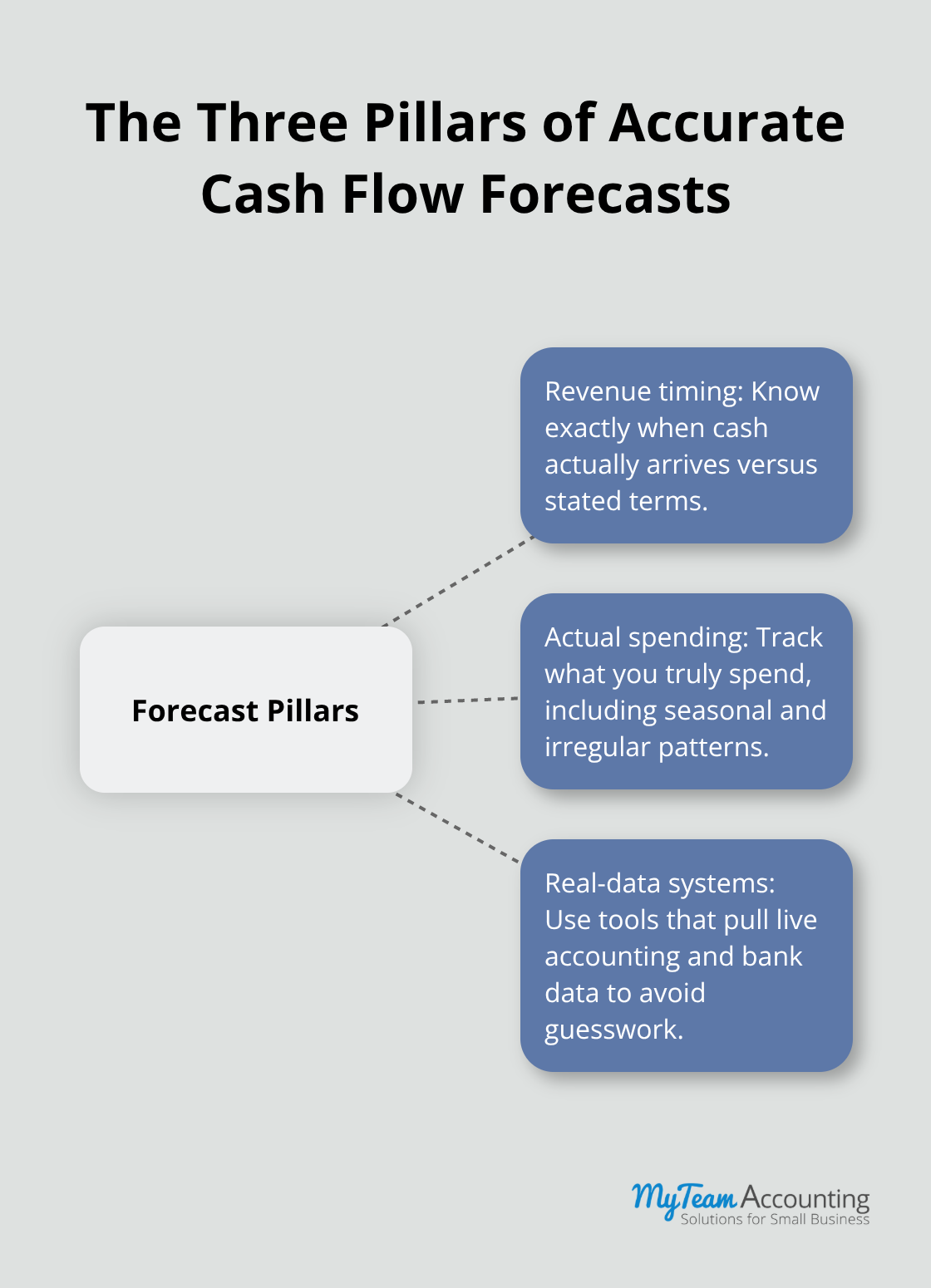
Export your last 12 months of transactions from QuickBooks Online or Xero and map revenue timing versus payment cycle assumptions. Most businesses discover their average payment cycle differs significantly from stated terms. A customer who theoretically pays net 30 might average net 42 because invoices sit unread or accounting departments batch payments. Calculate this gap for your top 10 customers separately because they drive most of your cash. If your three largest clients represent 60 percent of revenue but they pay 45 days on average, your forecast must reflect that reality, not the net 30 on their contracts.
Categorize Spending Into Three Distinct Buckets
Audit your actual spending over the past year. Export 12 months of bank and credit card transactions from both platforms and flag every expense over $500. This forces you to confront what you actually spend versus what you assumed. Most business owners discover annual expenses they forgot about completely: software renewals in Q2, insurance premiums that spike in specific months, or equipment maintenance that arrives unpredictably.
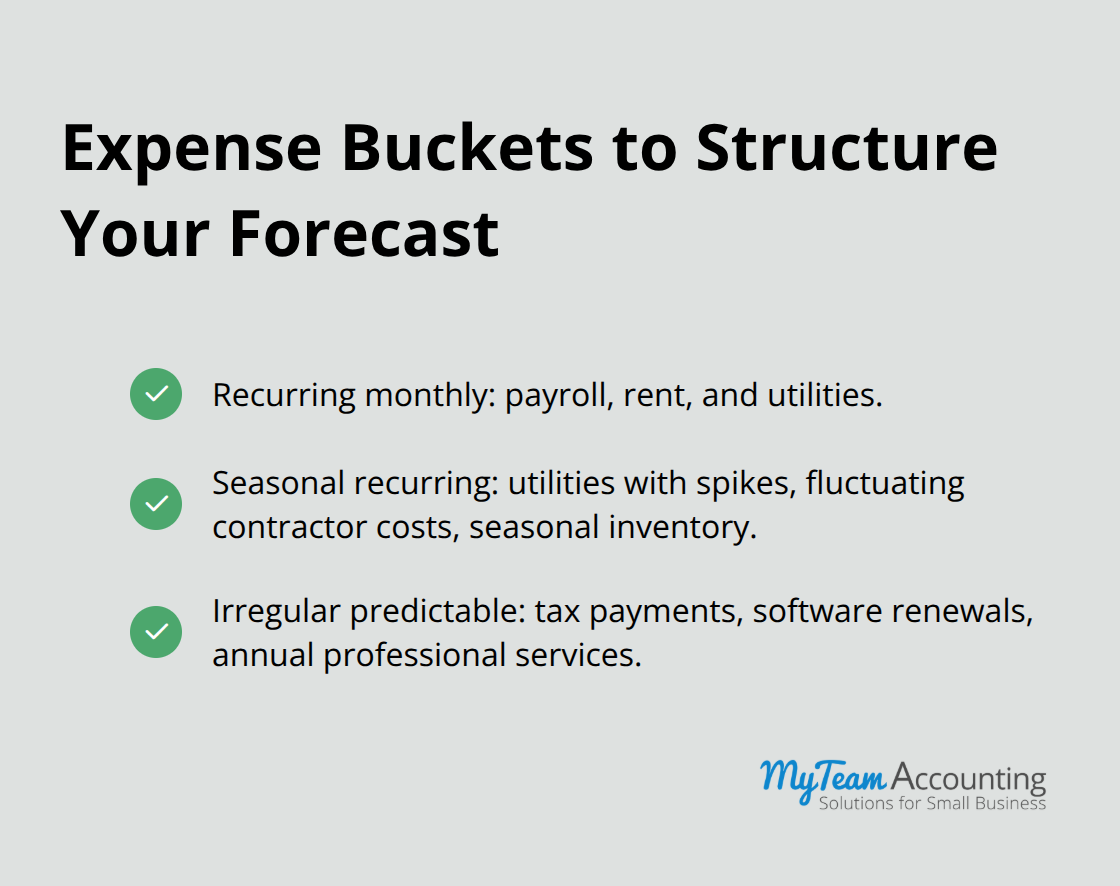
Categorizing business expenses into recurring monthly, seasonal recurring, and irregular predictable costs matters because it forces you to stop treating all expenses as equal when building your forecast. Your payroll, rent, and utilities go in the first category. Your utilities with seasonal spikes, contractor costs that fluctuate, and inventory purchases that concentrate in peak seasons go in the second category. Your tax payments, software license renewals, and annual professional services go in the third category.
Connect Your Accounting Platform to Automate Updates
Once you have actual revenue timing and actual spending patterns, connect QuickBooks Online or Xero directly to your forecast tool and automate the math. QuickBooks Online includes a built-in cash flow planner that pulls real data from your chart of accounts and linked bank accounts, eliminating the manual spreadsheet errors that plague static forecasts. Access it through Reports, then Financial Planning, then Cash Flow Planner. Select which accounts to display and choose your data source: bank transactions provide real cash movement while QuickBooks transactions let you include accrual-based items. Add planning items for known recurring income and expenses with amounts and optional recurring schedules, and the planner updates automatically as your bank data changes.
Xero users should connect all business bank accounts to their platform and use their short-term cash flow projections for the next 7 and 30 days, then extend to 60 or 90 days for medium-term planning. The critical discipline is updating your forecast weekly, not monthly. Set aside 10 to 15 minutes every Monday morning to compare what actually happened in your bank accounts against what your forecast predicted.
Adjust Assumptions When Reality Diverges From Projection
When reality diverges from projection, adjust your assumptions immediately. If a customer paid 10 days late, that is your new assumption for their next payment. If an expense arrived that you did not anticipate, determine whether it is truly irregular or whether you missed a pattern. This weekly discipline catches forecast drift before it becomes a crisis.
Most importantly, reject the temptation to round numbers or smooth reality. If your revenue is lumpy, your forecast should be lumpy. If your biggest expense comes in January, do not divide it by 12 and spread it across months. Use the actual timing. Forecasts built on averaged data and smoothed assumptions fail precisely because they do not reflect the business you actually run. With your forecast now grounded in real data and real timing, you can move forward to the practical tools and techniques that transform these projections into a system you monitor and act on every single week.
How to Monitor Cash Flow Without Waiting for Monthly Reports
Track Weekly Changes Against Your Forecast
The moment you stop updating your forecast is the moment it becomes useless. Weekly monitoring transforms a static document into an active management tool that catches problems before they become emergencies. Set a recurring calendar block for Monday morning-10 to 15 minutes-and compare what actually landed in your bank accounts against what your forecast predicted. This is not about perfection; it is about catching meaningful divergences early. If you forecasted $8,000 in customer payments but only $5,200 arrived, that $2,800 gap matters immediately because it affects whether you can comfortably cover payroll on Friday.
QuickBooks Online and Xero both update in real time as transactions post, so your actual cash position is never more than a day behind reality. Pull your cash flow planner or cash flow projection at the start of each week and note which line items varied from forecast. Did a customer pay late? Did an expense hit sooner than expected? Adjust that assumption for next week. Most small business owners wait until month-end to discover they are in trouble, but at that point options are limited and expensive. Weekly monitoring gives you 4 to 6 weeks of advance warning before a genuine shortfall hits, which is enough time to negotiate extended payment terms with suppliers, accelerate customer collections, or arrange a line of credit before desperation sets in.
Establish Alert Thresholds That Trigger Action
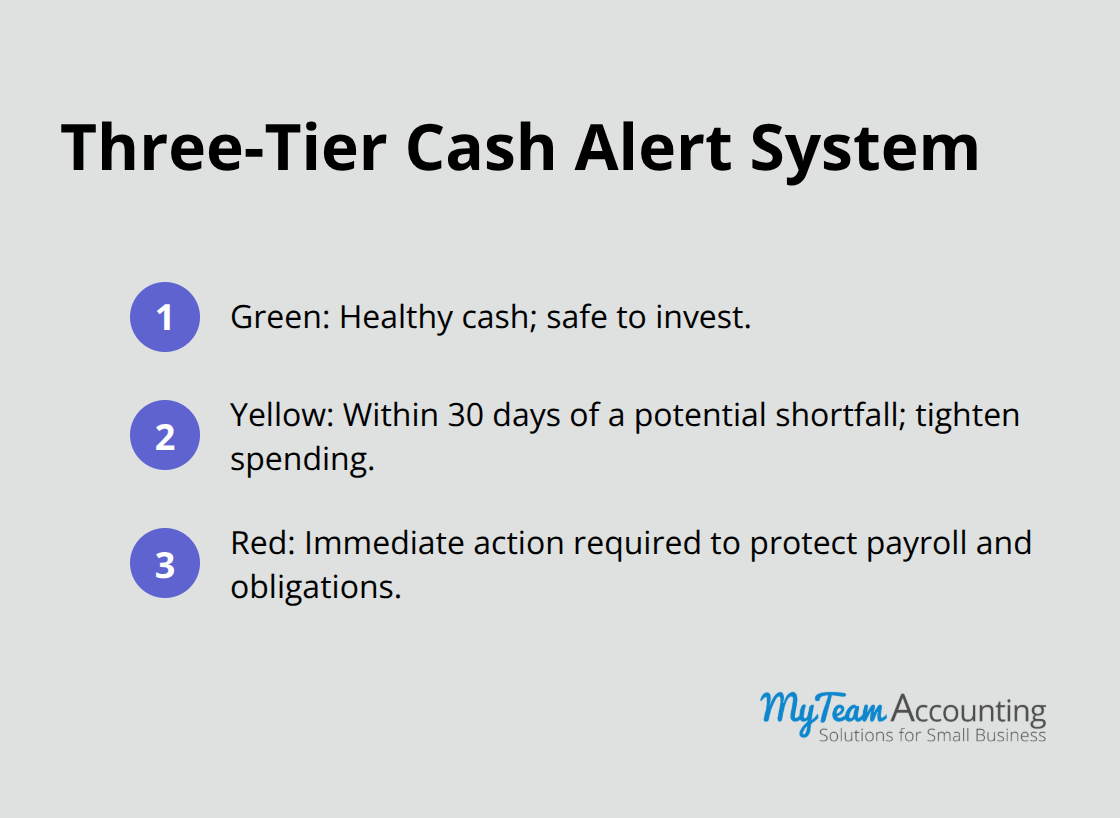
Set specific cash flow thresholds that trigger immediate action rather than waiting for your forecast to turn negative. If your business typically maintains $15,000 in operating cash but your 30-day projection shows you dropping to $8,000, that is your signal to pause discretionary spending or push customer invoices out faster. Some businesses use a three-tier alert system: green means cash position is healthy and you can make strategic investments, yellow means you are within 30 days of a potential shortfall and should tighten spending, red means immediate action required.
The discipline here is not about hoarding cash obsessively; it is about making spending decisions with full information about timing. If you know a major customer payment arrives on day 32 but payroll hits on day 30, you either arrange a bridge loan, negotiate a partial upfront payment, or adjust your hiring timeline. These decisions compound over time, and having an external perspective prevents the blind spots that plague solo business owners managing finances while running operations.
Leverage External Expertise for Pattern Recognition
An experienced outsourced CFO or bookkeeper can review your weekly numbers, spot patterns you might miss, and recommend specific actions tailored to your cash cycle. They ask the hard questions: Should you require 50 percent upfront deposits from new clients? Should you shift your biggest expense to a different month? Should you reduce payment terms from net 30 to net 15 for slow-paying customers? These professionals bring objectivity that internal teams often lack, especially when cash pressure mounts and emotions cloud judgment. Their recommendations prevent the blind spots that plague solo business owners managing finances while running operations simultaneously.
Final Thoughts
Three core disciplines transform cash flow from a source of stress into a strategic asset. You must ground your forecast in actual revenue timing and spending patterns rather than assumptions, automate data collection through QuickBooks Online or Xero so your numbers update weekly with real transactions, and monitor those numbers every Monday morning to catch divergences before they become crises. Most small business owners fail at forecasting not because the math is complex but because they treat it as a one-time exercise rather than an ongoing management practice that demands consistent attention.
Predictable finances enable confident strategic decisions that compound over time. When you know your cash position 60 to 90 days forward, you commit to hiring without fear of missing payroll, invest in systems that improve efficiency, and negotiate supplier terms from strength instead of desperation. Businesses that scale fastest are not those with highest revenue but those with most predictable cash positions, because predictability enables the confidence required for bold decisions about growth and investment.
Start this week by exporting your last 12 months of transactions from your accounting platform and mapping actual revenue timing versus payment cycles for your top customers. Categorize your spending into recurring, seasonal, and irregular buckets, then connect your platform to a forecasting tool and commit to a Monday morning review. Consider engaging an outsourced CFO or bookkeeper to review your patterns and recommend specific actions tailored to your cash cycle.