

5 Bookkeeping Habits That Save Small Businesses Hours Every Month
Most small business owners spend far too much time on bookkeeping tasks that could be automated or streamlined. The difference between chaotic finances and clean books often comes down to a few simple daily habits.
In this guide, we’ll share five practical bookkeeping tips that help small businesses reclaim hours every month. These organized finances strategies are designed to work immediately, whether you’re managing books solo or with a team.
1. Automate Invoice and Payment Tracking
Most small businesses lose money to late payments simply because follow-ups happen sporadically or not at all. Setting up automatic payment reminders in your accounting software eliminates this revenue leak entirely. The system can be configured to send follow-ups at strategic intervals-due date, 7 days, 14 days, and 30 days overdue-without you lifting a finger. QuickBooks Online and Xero both offer native reminder automation that takes 10 minutes to configure.
Real-time income categorization by client or project delivers the second efficiency gain. Instead of spending hours monthly sorting through transactions, your accounting software assigns each payment to the correct customer or project automatically when it lands in your bank account. For businesses with 20+ regular clients, this saves roughly 4-6 hours per month that would otherwise vanish into manual data entry. Recurring invoice templates streamline your business processes, improve cash flow, minimize human error, and reduce the administrative burden of manual billing. You create one template for your monthly retainer client, set it to generate automatically on the first of each month, and the invoice appears in your system without any action from you.
These automation wins free up your team to focus on higher-value work. With invoices and reminders handled automatically, your attention shifts to the next critical habit that keeps your finances truly clean.
2. Reconcile Bank Accounts Weekly Instead of Monthly
Most small business owners wait until month-end to reconcile their bank accounts, which means errors, duplicate charges, and fraudulent transactions sit undetected for weeks. Reconcile bank accounts weekly catches problems while they’re still fresh and easy to trace. When you reconcile every Friday afternoon, a missing $500 payment or an unauthorized charge surfaces immediately instead of hiding in a pile of 200+ transactions at month-end. This weekly discipline prevents small discrepancies from snowballing into major headaches during tax season. QuickBooks Online and Xero both let you set up bank feeds that pull transactions automatically, cutting your reconciliation time in half compared to manual entry.
The real benefit extends beyond fraud detection into day-to-day cash management. Many small business owners make payroll or vendor payment decisions based on what they think is in the bank, not what actually is. Weekly reconciliation gives you an accurate cash position for Monday morning decisions, which means you’ll never overdraw an account or miss a payment deadline because your records were two weeks stale. Spreading reconciliation across the entire month also eliminates the dreadful Monday morning when you face 300 transactions to match and approve. Your team stays calmer, your books close faster, and your accountant spends less time fixing reconciliation errors when you hand over clean, verified data each month-leaving room to focus on the next habit that transforms your financial foundation.
3. Maintain a Clear Chart of Accounts Structure
A bloated chart of accounts silently kills profit for small businesses. Most owners accept the default account structure from their accounting software and never revisit it, which leaves them with 40+ accounts where 15 would suffice. When your chart contains unused accounts, duplicate categories, and vague naming conventions, your financial reports become noise instead of insight. You’ll spend hours each month trying to understand where money actually went, and your accountant will spend billable time decoding your structure during tax season. The fix is straightforward: design your chart of accounts around how you actually run your business, not how the software suggests it should look.
Start by eliminating accounts you don’t track separately. If you don’t analyze separate revenue streams, collapse them into one account. If you’ll never need to examine marketing spend by channel, consolidate those accounts into a single marketing expense category. A lean, purposeful chart of accounts takes 2-3 hours to build correctly but saves 8-10 hours monthly in reporting and analysis work. Clean account structure directly impacts tax preparation speed and accuracy-when your accountant receives books with clear, logical accounts that map directly to tax return line items, they can file your return in half the time compared to untangling a chaotic structure.
Schedule an annual review of your chart of accounts each November to remove dormant accounts, consolidate similar categories, and rename vague entries before year-end closes. This 90-minute conversation with your accountant or bookkeeper prevents the January scramble and ensures your financial statements reflect your business reality. With a clean foundation in place, you’re ready to tackle the next habit that transforms how you handle the most common source of bookkeeping chaos: mixing personal and business finances.
4. Separate Personal and Business Finances Completely
Mixing personal and business expenses creates a financial mess that compounds monthly and explodes during tax season. Most small business owners underestimate this problem until they face an IRS audit or encounter expensive issues like tax fines and poor financial decisions. Open a dedicated business bank account immediately and use it exclusively for business revenue and expenses-never deposit personal income into this account, and never pay personal bills from it. This single boundary eliminates the largest source of bookkeeping chaos and reduces your accountant’s cleanup work from hours to minutes.
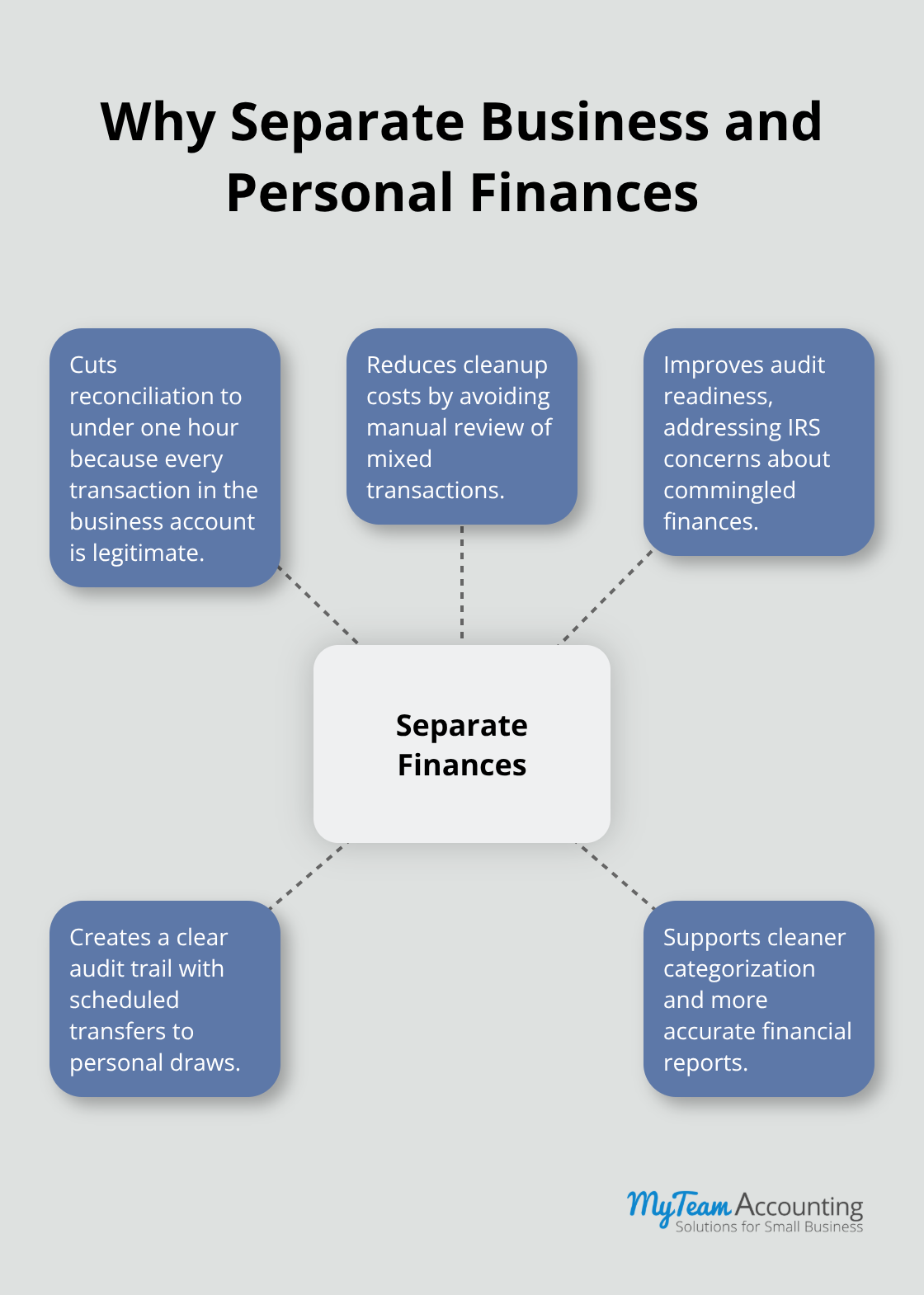
When your accountant receives books where personal and business transactions are mixed, they must manually review every single transaction to determine what’s deductible and what isn’t. A dedicated business account cuts this reconciliation time to under one hour because your accountant knows every transaction in that account is legitimate business activity. Additionally, maintaining separate accounts makes you audit-ready immediately-the IRS views commingled finances as a red flag, but a business account with clean categorization and supporting documentation demonstrates intentional financial management.
Set up automatic transfers from your business account to a personal draw account on a fixed schedule, such as the 15th and 30th of each month, rather than taking random withdrawals. This approach creates a clear audit trail, simplifies your personal tax return, and keeps your business books genuinely clean month after month. With your finances properly separated, you’re positioned to establish the final habit that ensures consistency and prevents costly errors across your entire organization.
5. Document Your Process and Train Your Team
Most small businesses operate with unwritten bookkeeping procedures that exist only in one person’s head, which means every absence, vacation, or departure creates a crisis. When your accounts payable specialist leaves without documenting how they match invoices to purchase orders, the next person wastes time figuring out the workflow from scratch. The solution is creating a single-page process checklist for every recurring bookkeeping task: invoice approval, expense categorization, payroll verification, and bank reconciliation. These checklists specify exact steps, required approvals, and decision rules. For example, your expense approval checklist might require that all purchases over $500 need manager sign-off before payment, that receipts attach within 48 hours, and that the expense category matches your chart of accounts structure.
Establishing clear approval workflows prevents the financial chaos that emerges when multiple people handle transactions without guardrails. A small retailer processing 200 transactions monthly across multiple team members will experience duplicate entries, miscategorized expenses, and unapproved purchases without documented workflows. Assign specific approval authority: the owner approves payroll, the office manager approves vendor payments under $1,000, and the accountant reviews everything monthly. When these rules exist in writing and are accessible to your team, errors drop significantly within the first month. Document these workflows in a shared spreadsheet or simple operations manual that your team can reference daily, and update it quarterly as your business changes.
This investment in process documentation transforms bookkeeping from a bottleneck dependent on one person into a scalable system that survives growth and staff transitions. With your internal systems locked in place, the final step involves connecting your bookkeeping foundation to professional guidance that accelerates growth and prevents costly financial missteps.
Final Thoughts
The five bookkeeping habits outlined above transform your finances from reactive chaos into proactive management. Automating payment reminders eliminates one follow-up call per week, weekly reconciliation prevents one costly error per month, a clean chart of accounts cuts reporting time by half, separated finances reduce accountant fees by hundreds annually, and process documentation prevents one crisis per quarter when staff transitions occur. These individual wins accumulate into dozens of hours reclaimed each year and thousands of dollars in reduced accounting fees, proving that small business books thrive on consistency rather than heroic effort.
Clean books create the financial clarity that confident decisions require. When your organized finances stay current and accurate, you answer critical questions instantly: Are we profitable this month? Which clients generate the most revenue? Where is money actually being spent? Can we afford to hire someone new? These answers drive strategy instead of guesswork, and you spot problems earlier while capitalizing on opportunities that chaotic finances would hide.
The final step involves partnering with an accounting professional who understands your business and implements these systems correctly. A bookkeeper or accountant working with you monthly ensures your small business books stay clean, catches issues before they become expensive, and provides guidance on tax planning and financial strategy. Schedule a consultation with a local accounting professional to discuss which of these five bookkeeping tips would have the biggest impact on your business first, then build from there.