

Payroll Compliance Essentials: Core Requirements for Your Team
Payroll compliance essentials form the foundation of every successful business operation. Without proper systems and knowledge, companies face costly penalties, legal disputes, and damaged employee relationships.
This guide walks you through the core requirements your team needs to understand and implement. You’ll discover common pitfalls to avoid and proven strategies for maintaining compliance year-round.
Federal Tax Withholding, Classification, and Wage Compliance
What Your Payroll System Must Handle
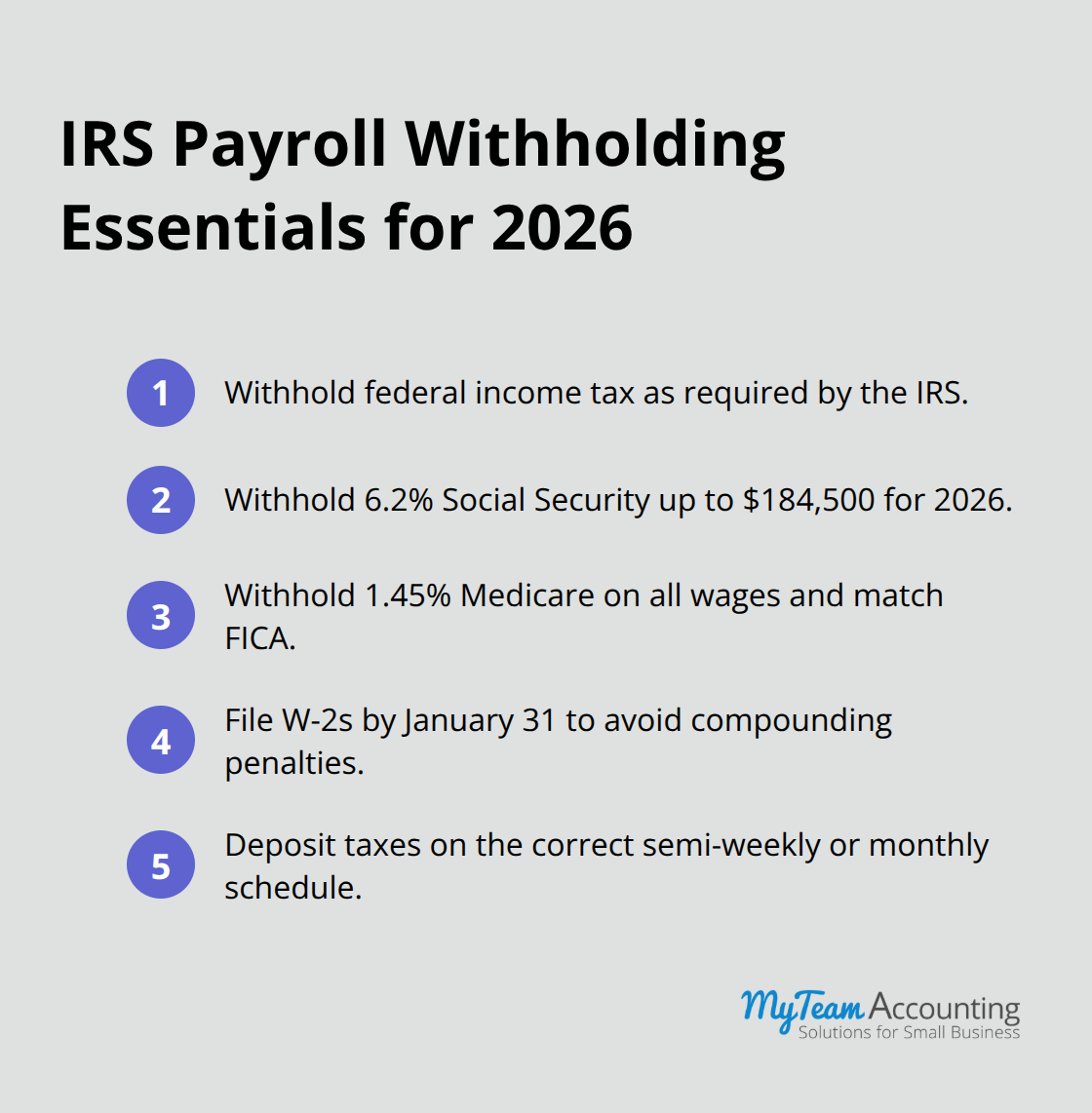
Federal tax withholding demands precision from day one. The IRS requires employers to withhold federal income tax, Social Security tax at 6.2 percent on wages up to $184,500 in 2026, and Medicare tax at 1.45 percent on all wages, with employers matching these FICA amounts. Form W-4 determines withholding accuracy, yet many businesses fail to update employee forms when tax laws change or when workers experience life events that shift their filing status.
State income tax withholding varies dramatically by jurisdiction. Employers operating across multiple states face exponentially higher complexity. A business with employees in California, Texas, New York, and Florida must navigate four different withholding systems, each with distinct rates, forms, and filing deadlines. Local taxes add another layer of burden, with some cities requiring payroll tax deposits separate from state systems.
Minimum Wage and Overtime Obligations
The Fair Labor Standards Act minimum wage and overtime requirements sets the federal minimum wage floor at $7.25 per hour, yet your actual obligation depends on where your employees work. California and Massachusetts mandate $16.50 and $15.00 minimum wages respectively in 2026, meaning you must always apply the higher standard. Overtime calculations must account for the regular rate of pay, which includes non-discretionary bonuses and shift differentials, not just base hourly wages. Misclassifying a worker as exempt from overtime liability exposes your business to wage-and-hour lawsuits, back-pay liability, and Department of Labor audits that assess penalties reaching thousands of dollars per violation.
Employee Status Determines Everything
Classifying workers as employees versus independent contractors ranks among the costliest mistakes in payroll operations. The IRS applies a multi-factor test examining behavioral control, financial control, and the relationship type, and getting this wrong triggers back taxes, unemployment insurance liability, and potential benefits obligations. A worker who receives detailed instructions, uses your equipment, and works exclusively for your business should almost certainly be an employee, regardless of what your contract states. Misclassified contractors generate liability that extends years backward, so audit your current workforce immediately using IRS guidance.
Exempt Versus Non-Exempt Classification
Employee classification determines FLSA protections, meaning non-exempt workers must receive overtime pay while exempt employees do not. The salary threshold for exempt classification starts at $35,568 annually as of 2026, yet salary alone does not determine exemption. Duties tests matter equally, requiring that exempt employees perform executive, administrative, or professional work involving significant discretion and independent judgment. Many businesses incorrectly exempt salaried employees who perform routine tasks, creating exposure to wage claims.
Tracking Hours and Time Records
Your payroll system must track hours for all non-exempt workers with precision, capturing actual time worked including travel time to job sites and mandatory training sessions. Rounding time punches to the nearest 15 minutes is permissible under the FLSA, but systematically rounding in the employer’s favor violates wage laws and triggers audits from state labor departments. Accurate time records form the foundation for overtime calculations and protect your organization during wage-and-hour investigations. With these foundational requirements in place, your next priority involves identifying and avoiding the specific mistakes that derail payroll operations across industries.
Three Mistakes That Drain Your Payroll Budget
Contractor Misclassification: Your Costliest Error
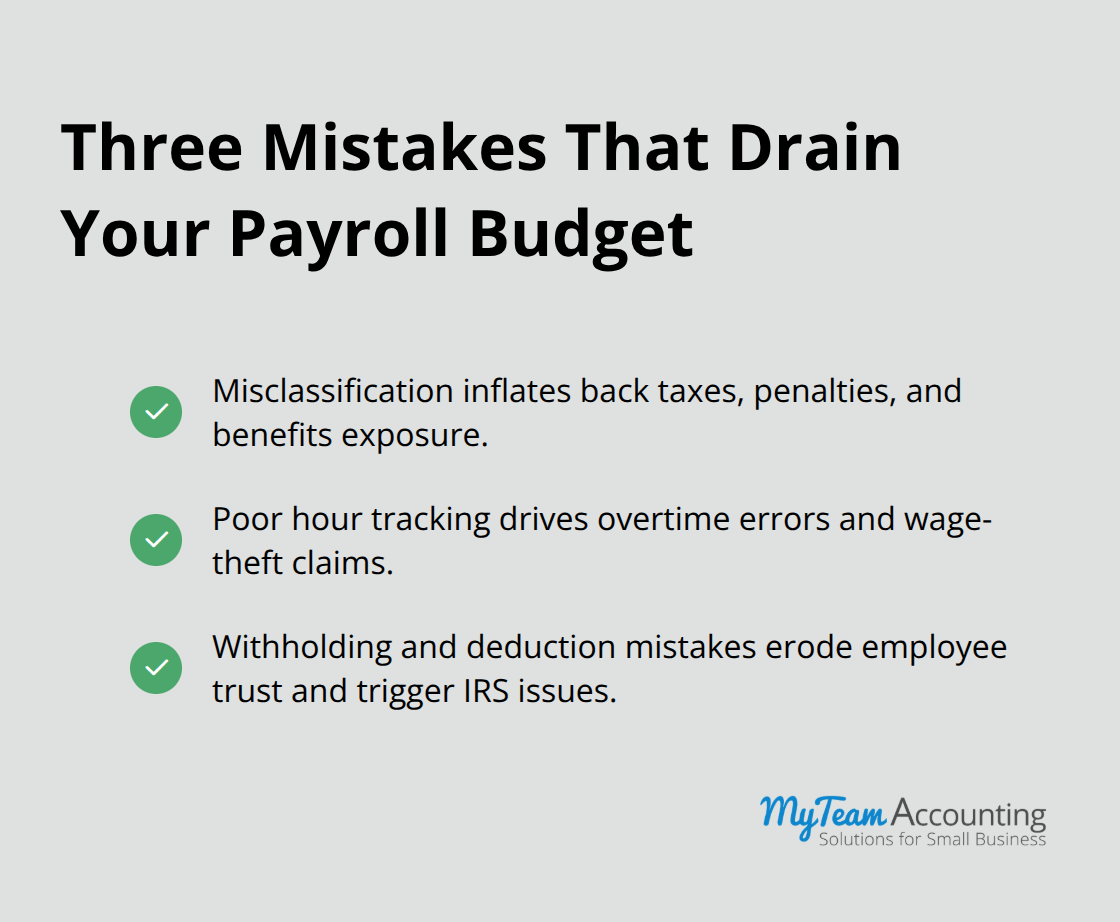
Contractor misclassification stands as the single most expensive payroll error your business can make. The IRS applies a three-part test examining behavioral control, financial control, and the relationship between worker and company, yet most businesses fail this test catastrophically. A worker who follows your detailed instructions, uses equipment you provide, and performs services exclusively for your organization should be classified as an employee, period. IRS enforcement data shows that misclassified workers generate back taxes, employer and employee FICA contributions owed retroactively, unemployment insurance liability, and potential penalties reaching 100 percent of unpaid taxes. One misclassified worker earning $50,000 annually for three years can trigger $25,000 or more in unexpected liability. State labor departments now actively audit contractor classifications, and a single audit can expose your entire workforce to reclassification demands.
You must audit every contractor relationship immediately using IRS Form SS-8 guidelines. Document the reasoning for independent contractor status in writing, and convert questionable relationships to employee status today rather than facing audits tomorrow.
Hour Tracking Failures and Overtime Exposure
Hour tracking failures compound payroll damage because they affect overtime calculations, wage theft claims, and audit readiness simultaneously. Many businesses permit managers to estimate hours for non-exempt workers, round time entries in inconsistent directions, or fail to capture travel time and mandatory training as compensable hours under FLSA rules. The Department of Labor considers any rounding that systematically favors the employer as wage theft, and state attorneys general now pursue these cases aggressively. Failing to track hours accurately also means your overtime calculations are wrong, exposing you to wage-and-hour lawsuits where plaintiffs’ attorneys recover treble damages plus attorney fees.
Your payroll system must capture actual time worked with precision, categorize time by pay rate and overtime status, and generate audit trails showing all time entries and modifications. These controls protect your organization during wage-and-hour investigations and demonstrate good-faith compliance efforts to regulators.
Deductions and Withholdings: The Trust Destroyer
Neglecting deductions and withholdings destroys employee trust and creates tax compliance failures that invite IRS penalties. Employees frequently submit new W-4 forms after life events, yet many payroll teams ignore these updates and continue withholding at old rates, leaving employees with unexpected tax bills in April. Equally critical, pre-tax benefit deductions like health insurance and 401(k) contributions must start on exact dates specified in plan documents, and errors here trigger nondiscrimination test failures that can disqualify entire retirement plans.
You must audit your current deduction setup immediately: verify that all W-4 forms are dated within the last two years, confirm that benefit deductions match employee elections, and run a sample calculation to ensure withholding accuracy across your workforce. These three mistakes-misclassification, hour tracking, and withholding errors-represent the most common paths to payroll liability, yet they remain entirely preventable through systematic attention and proper controls.
How to Build a Payroll System That Prevents Errors
Automate Calculations and Tax Compliance
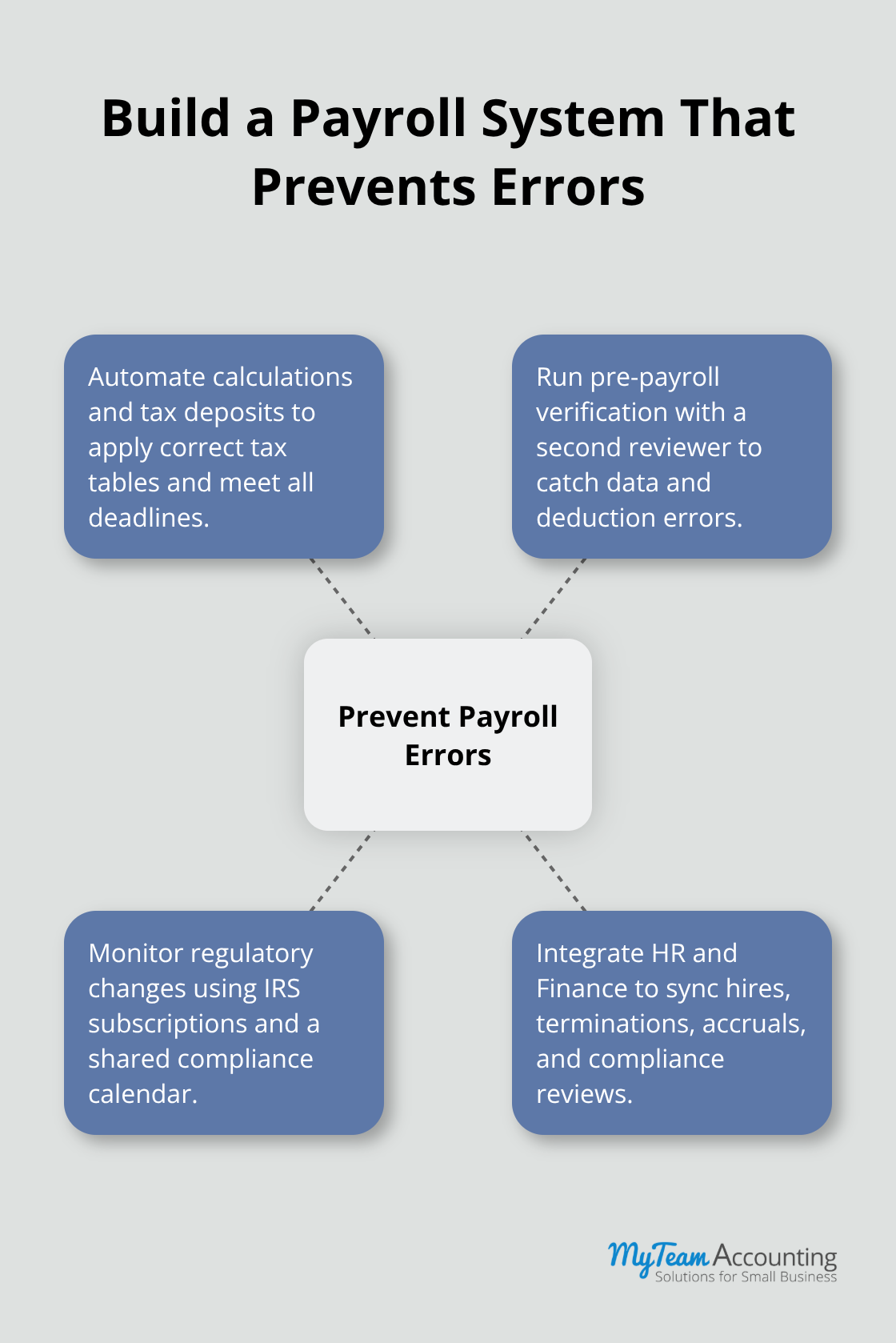
Automated payroll software eliminates manual entry mistakes that trigger wage-and-hour liability and tax penalties. Businesses using modern payroll systems reduce withholding errors by over 90 percent compared to spreadsheet-based operations, yet implementation requires more than simply purchasing software. Your system must integrate directly with your timekeeping data to eliminate the manual hour entry step where most errors occur. Configure your payroll software to calculate overtime thresholds automatically, apply the correct tax tables for each jurisdiction where you employ workers, and flag any entry that deviates from historical patterns. Set up automated tax deposits so payments route to federal, state, and local authorities on exact IRS and state agency deadlines without manual intervention.
Establish Pre-Payroll Verification Controls
A second set of eyes catches data entry errors, missing deductions, and rate changes that slip through during setup. Establish a pre-payroll verification process where someone other than the payroll processor audits the preliminary payroll register before final submission. Run spot checks on at least 10 percent of your employee records monthly, comparing time records to payroll entries, verifying pay rate accuracy, and confirming that all deductions match current employee elections. Document these audits in writing and retain records for at least three years as required by the Fair Labor Standards Act. This systematic approach transforms payroll from a liability risk into a controlled, auditable function.
Monitor Regulatory Changes Actively
Regulatory changes happen constantly, and staying current requires deliberate systems rather than relying on third-party alerts that often arrive weeks late. Subscribe directly to IRS updates through the agency’s email notification system to catch changes immediately. For 2026, the 401(k) limit rose to $24,500 according to the IRS, yet many businesses missed these changes entirely because they did not monitor official sources. Create a compliance calendar on your team’s shared system with hard deadlines for quarterly Form 941 filings, annual W-2 distribution by January 31, state unemployment return deadlines, and tax table updates. Assign specific team members responsibility for each deadline and build in a two-week buffer before each date to allow time for corrections. Attend at least one payroll-focused webinar or training session quarterly through the IRS or your state labor department to catch regulatory shifts before they impact your operations.
Integrate Payroll with HR and Finance Functions
Your payroll function should never operate in isolation from your HR and finance teams.
Final Thoughts
Payroll compliance essentials rest on three foundational pillars: accurate federal and state tax withholding, correct employee classification, and precise hour tracking with proper overtime calculations. Organizations that master these requirements eliminate the costliest mistakes that drain budgets and expose businesses to regulatory penalties. Automated payroll software reduces processing errors by over 90 percent compared to manual operations, freeing your team to focus on strategic HR initiatives rather than firefighting compliance crises.
Employees trust organizations that pay them accurately and on time, and this trust directly impacts retention and engagement. When your payroll function operates with precision, finance teams gain reliable data for budgeting and forecasting, and leadership can confidently report to stakeholders that employment practices meet all legal requirements. Start today by auditing your current payroll operation against the requirements outlined in this guide: review every contractor relationship using IRS Form SS-8 guidelines, verify that your time tracking system captures actual hours worked with precision, and confirm that all W-4 forms remain current.
Schedule a meeting with your HR and finance teams to establish the cross-functional communication structure that prevents compliance gaps from widening into liabilities. Commit to staying current with regulatory changes by subscribing directly to IRS updates and creating a compliance calendar with hard deadlines for quarterly filings, annual reporting, and tax table updates. Payroll compliance operates as an ongoing operational discipline that protects your organization, your employees, and your bottom line.