

Outsourced Payroll Processing: Efficiency You Can Trust
Running payroll manually drains time and invites costly mistakes. Outsourced payroll processing eliminates these headaches by automating calculations, tax withholdings, and compliance-letting you focus on what actually grows your business.
Small business owners who delegate payroll gain peace of mind and reclaim hours each week. The right provider handles everything from direct deposits to regulatory filings, so you don’t have to.
Why Small Businesses Outsource Payroll
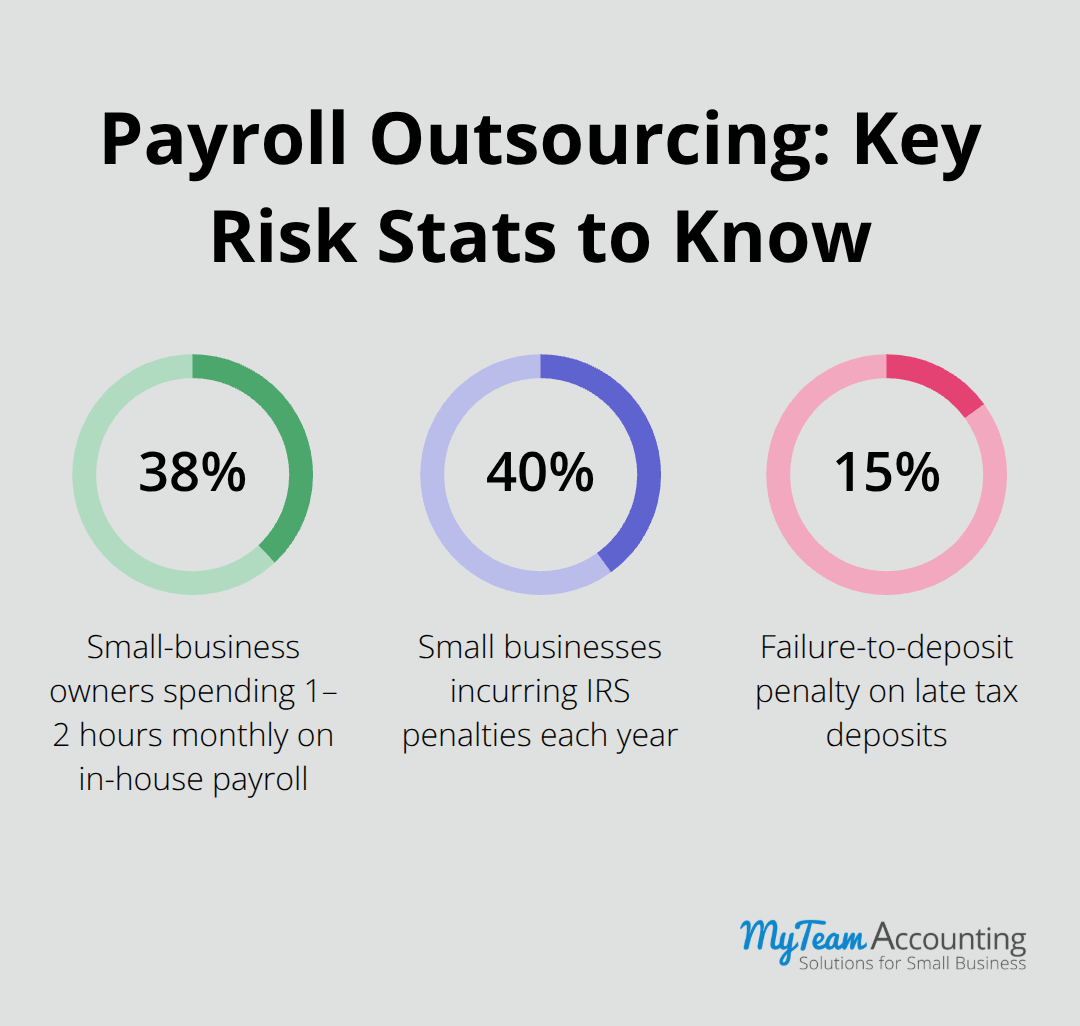
Small business owners waste staggering amounts of time on payroll that could fuel growth instead. According to the National Small Business Association’s 2025 survey, 38 percent of small-business owners spend between one and two hours monthly on in-house payroll, while others dedicate significant additional time. That translates to weeks of lost productivity annually. Beyond time theft, the financial damage from DIY payroll runs deep. The math becomes brutal when you layer in error rates: companies have an average payroll error rate of 1.2% each pay period, and roughly forty percent of small businesses incur an average of eight hundred forty-five dollars in IRS penalties each year. Late tax deposits trigger a fifteen percent failure-to-deposit penalty plus half a percent monthly on unpaid taxes, and misclassifying workers as independent contractors creates wage-hour and tax compliance exposure that compounds quickly. When you outsource payroll to a professional provider, these expenses and hours vanish. The provider calculates wages accurately, withholds the correct tax amounts, files all required forms, and deposits payments on schedule. Your team stops wrestling with tax code changes across multiple states and starts focusing on customer acquisition, product development, and revenue expansion.
Time Liberation Changes Everything
Reclaiming ten to twenty hours monthly sounds abstract until you realize what your leadership could accomplish with that time back. Sales owners could prospect new accounts. Service-based businesses could deepen client relationships. Retail operators could refine inventory strategy. Instead, most spend that time on spreadsheets, tax tables, and IRS notices. A professional payroll provider eliminates the guesswork entirely. The provider handles wage calculations, tax withholding, remittance scheduling, regulatory compliance, reporting, and year-end forms so your business validates data and moves forward. The efficiency gain extends beyond just hours saved; it reduces the mental burden of compliance deadlines and regulatory uncertainty that haunts every payroll cycle.
Penalties and Risk Collapse When You Outsource
IRS penalties accumulate fast when payroll errors occur in-house. Worker misclassification, incorrect withholding, missed deposit deadlines, and filing errors each carry distinct penalties that add up to thousands. Reputable payroll providers monitor tax law changes continuously, stay current across all fifty states, and maintain audit documentation that protects your business during IRS inquiries. This proactive compliance management is nearly impossible to replicate internally without a dedicated payroll accountant on staff. The cost of outsourcing becomes trivial compared to a single major penalty or an audit that demands months of record reconstruction.
What Happens Next
Your next decision involves selecting the right provider-one that integrates seamlessly with your accounting systems, offers responsive support, and charges transparent fees without surprises.
What Professional Payroll Services Actually Deliver
Accuracy That Eliminates Costly Errors
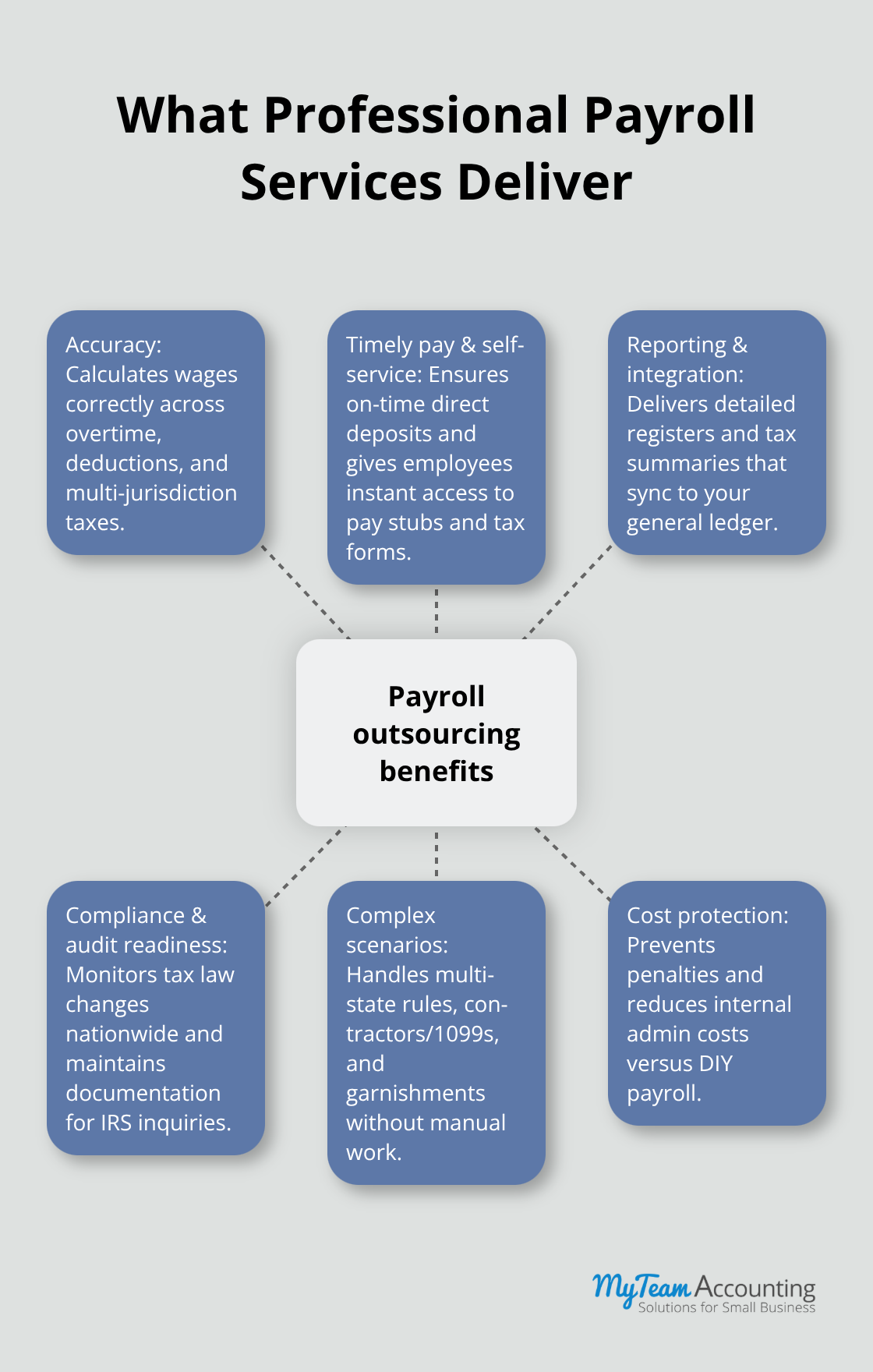
Professional payroll providers eliminate the precision problems that plague in-house systems. When a provider calculates wages, they account for overtime rules, shift differentials, deductions, and tax withholdings across federal, state, and local jurisdictions simultaneously-something spreadsheets fail at consistently. A single miscalculation on one employee’s federal withholding can trigger IRS correspondence that demands hours of your time to resolve, so accuracy matters enormously. Providers use real-time tax tables updated throughout the year, so when tax law changes mid-cycle, your payroll adjusts automatically rather than requiring manual intervention. This real-time approach prevents the errors that accumulate when businesses rely on outdated tax information or manual calculations.
Timely Payments and Employee Self-Service
Direct deposit hits employee accounts on schedule without exception, which eliminates the administrative burden of issuing checks and prevents the morale damage that late paychecks inflict. Employees access self-service portals where they view pay stubs, verify tax withholdings, and download tax forms instantly, which reduces HR questions and strengthens employee confidence in their compensation. This transparency improves employee satisfaction and frees your team from repetitive payroll inquiries that consume hours each pay period.
Reporting That Connects to Your Accounting Systems
The reporting capability separates professional providers from DIY systems entirely. You receive detailed payroll registers showing gross pay, deductions, and net amounts by employee; tax liability summaries broken down by jurisdiction; and year-end reconciliation reports that match your general ledger perfectly. Integration with accounting systems means your bookkeeper or CFO never wastes time manually transferring payroll data or hunting discrepancies between systems. Audit documentation flows automatically into organized files that survive IRS scrutiny, which proves critical when audits occur. Most providers maintain compliance records across all fifty states plus local jurisdictions where you operate, so the recordkeeping burden disappears entirely.
Handling Complex Payroll Scenarios
The practical advantage extends to complex scenarios that break DIY systems. If you operate across three states with different wage-and-hour rules, a provider handles the jurisdictional complexity without requiring you to maintain separate payroll knowledge. If you manage contractors alongside employees, the provider files 1099 forms correctly and tracks the threshold increase for 1099-NEC and 1099-MISC reporting. If you process garnishments, the provider calculates court-ordered deductions accurately and files required documentation with courts. These capabilities exist because payroll providers invest in compliance infrastructure that individual businesses cannot justify building internally.
Investment That Protects Your Bottom Line
The cost structure typically includes a per-payroll processing fee plus an annual base fee, which remains far cheaper than the cost of a single IRS penalty or the salary required to hire a dedicated payroll specialist. Your team gains access to advanced tools and cloud-based reporting without heavy upfront investment in software licenses or training programs. With payroll handled reliably, you’re ready to evaluate which provider aligns best with your business needs and accounting infrastructure.
How to Choose a Payroll Provider That Actually Fits Your Business
Selecting a payroll provider feels overwhelming until you focus on three concrete criteria that determine whether the partnership succeeds or creates new problems. The first mistake most small business owners make is treating all providers as interchangeable commodities. They aren’t. A provider that works beautifully for a retail operation with twenty employees might create friction for a professional services firm with contractors spread across four states. Your selection process must start with your actual operational reality, not generic feature checklists.
Integration Determines Your Real Workload
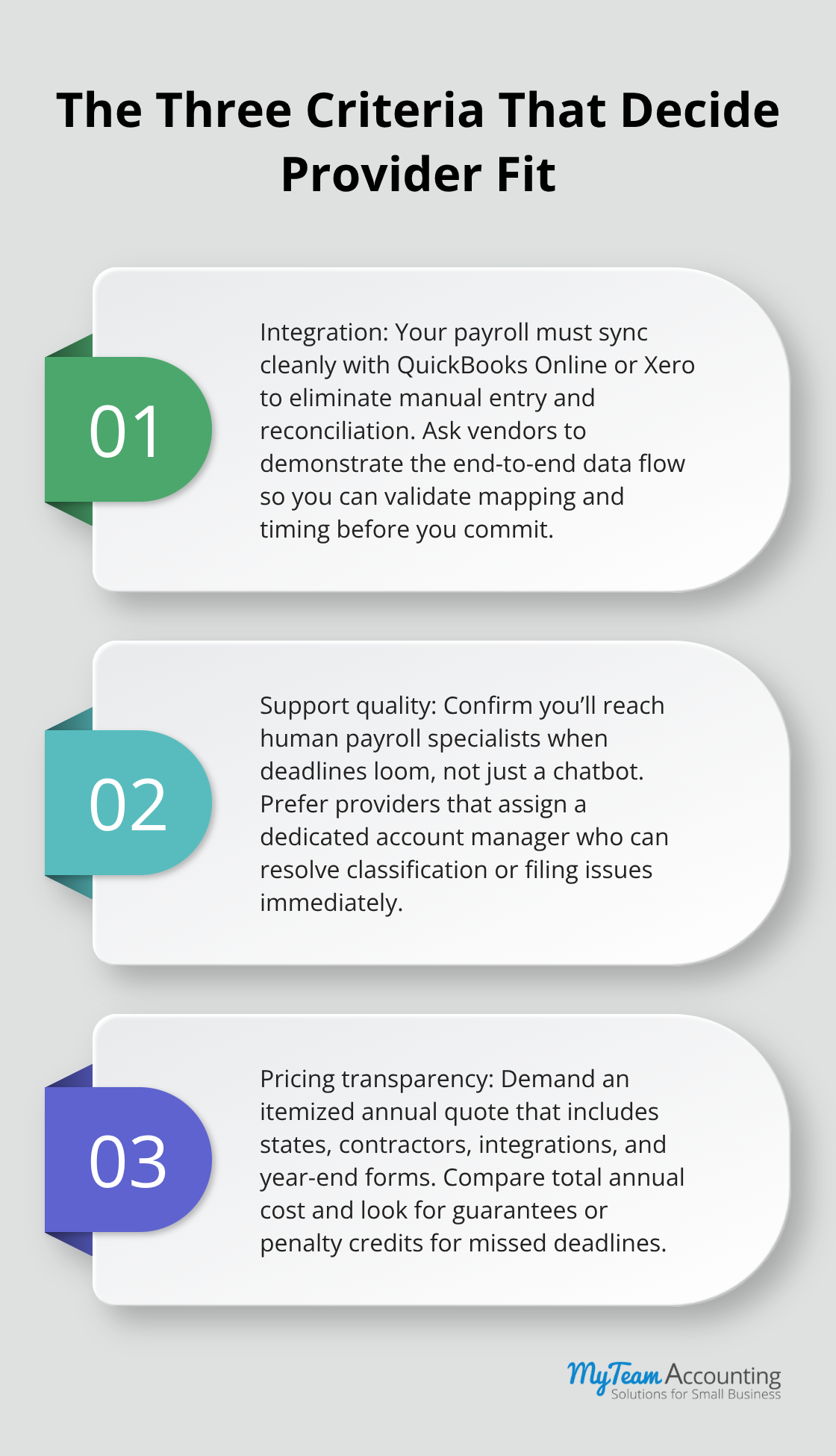
The integration question separates efficient implementations from ones that multiply your work instead of reducing it. If you use QuickBooks Online or Xero for accounting, your payroll provider must sync data automatically so your bookkeeper never manually enters payroll totals into your general ledger. This isn’t a nice-to-have feature; it’s essential. Without integration, you still spend five to ten hours monthly reconciling payroll data between systems, which defeats the entire purpose of outsourcing. Ask potential providers specifically how they integrate with your accounting platform and request to see the data flow in action before signing anything.
When you evaluate integration capabilities, ask whether the provider handles multi-state tax remittance reporting that connects to your tax liability accounts in QuickBooks or Xero. This detail matters enormously when you operate across jurisdictions because accurate tax liability tracking prevents month-end surprises and audit headaches. If a provider can’t demonstrate seamless integration with your specific accounting software, their pricing advantage disappears because your internal team still carries the burden of data management.
Support Quality Separates Reliable Providers from Risky Ones
Most payroll providers claim to offer 24/7 support, but you need to understand what that actually means. Some provide automated chatbots that answer questions about account access but connect you to human specialists only during business hours. Others staff real payroll professionals around the clock who can solve problems immediately. The difference becomes critical when a payroll processing deadline approaches and you discover an employee classification issue or a state tax filing discrepancy. You don’t want to wait until Monday morning to resolve it.
Call the support number of any provider you’re seriously considering and ask specific questions about a hypothetical problem: if an employee reports incorrect tax withholding three days before payroll processes, can a specialist fix it immediately, or does it wait for the next cycle? Their answer reveals whether support is actually reactive or genuinely proactive. Additionally, evaluate whether the provider assigns you a dedicated account manager or relationship contact rather than treating you as a ticket number in a queue. Smaller, specialized providers often excel here because they maintain genuine relationships with clients rather than managing thousands of accounts through support tickets. Ask for references from businesses similar to yours in size and industry, then actually call those references and ask specific questions about support responsiveness during critical moments.
Pricing Transparency Prevents Budget Surprises
Payroll provider pricing typically includes a per-pay-period processing fee ranging from thirty to seventy dollars depending on frequency and complexity, plus an annual base fee that covers system access and compliance management. But here’s where many businesses get blindsided: providers add surprise charges for features you thought were included. Some charge extra for each state where you process payroll, others charge per contractor, and some add fees for integration with accounting software or employee self-service portal access.
Before committing, request a detailed quote that itemizes every charge you’ll incur annually based on your specific situation. Include your current employee count, number of pay periods annually, states where you operate, number of contractors, and any special requirements like garnishment processing. Compare total annual cost across at least three providers rather than focusing on the per-pay-period fee alone, which can be misleading. A provider charging sixty dollars per payroll but adding state fees might cost more than one charging eighty dollars per payroll with all features bundled (including integration setup, year-end form preparation, tax deposit scheduling, and employee self-service portal access). Ask specifically whether the quote includes these services or whether any are separate line items. Finally, ask whether the provider offers any performance guarantees or penalty credits if they miss payroll deadlines or make processing errors. Providers confident in their service often guarantee on-time processing and offer credits if they fail, which protects you if something goes wrong.
Final Thoughts
Outsourced payroll processing transforms how small businesses operate by eliminating the administrative burden that drains resources and invites costly mistakes. When you delegate payroll to a professional provider, you reclaim the time your leadership needs to drive growth, strengthen customer relationships, and execute strategic initiatives that actually move your business forward. The hours you save each month compound into weeks annually, time that directly impacts your bottom line and competitive position.
Professional payroll services protect your business through expert compliance management that stays current with evolving tax laws across all jurisdictions where you operate. Providers monitor regulatory changes continuously, file required forms accurately, and maintain audit documentation that shields you from penalties and IRS scrutiny (something nearly impossible to replicate internally without hiring specialized payroll staff). This proactive protection makes outsourcing the practical choice for businesses of any size.
The selection process matters enormously-choose a provider whose systems integrate seamlessly with your accounting software, whose support team responds immediately when problems arise, and whose pricing remains transparent without hidden fees. Contact our team to discuss which provider aligns with your operational needs and to complete the onboarding process that redirects your team’s energy toward the work that builds your business.